Silbery's FAQ
Frequently.
Asked.
Questions.
New to metal roofing? Whether you’re planning a re-roof, fixing a leak, or need custom flashings made to order, here are the questions we get asked the most.
What is a
Flashing?
"Flashings are the bits nobody ever talks about, until they fail. Then suddenly you've got a waterfall inside your kitchen and a very memorable Tuesday. Get them right the first time and you'll never think about them again."
What is a flashing?
A flashing is a thin strip of metal that stops water sneaking into your house. Whenever a roof meets a wall, a chimney, a skylight, or any other surface, there's a join where rain can get in. Flashings cover those joins and send the water on its way. They're one of the most common roof leak repairs we do, and one of the easiest to prevent.
At Silbery, every flashing is custom made from the same material as your roof, so they match, they last just as long, and they expand and contract at the same rate as everything around them. Flashings are manufactured at both our Upper Hutt factory and Thorndon branch.
What is a Barge Flashing?
See those metal strips running along the sloped edges at the sides of your roof (where the roof ends at a gable wall)? Those are barge flashings.
They do three things: tidy up the roof edge, stop the sheets lifting in a big Southerly, and keep rain from blowing up underneath the roof. On a windy Wellington day, that last one is earning its keep every ten minutes. Replacement barge flashings are one of our most common orders, if yours are damaged or missing, we can manufacture new ones to match your existing roof.
What is a Ridge Cap?
The very top of your roof, where the two slopes meet at the peak, needs to be covered. That cover is called a ridge cap (or ridging).
It's a curved or flat piece of metal that sits over the peak and keeps rain out of the gap at the top. It's also designed to flex slightly as the roof heats up and cools down, so it doesn't pop loose over time.
What is a Valley?
When two roof slopes meet going inward, like the inside of a "V", all the rain from both sides funnels down into that join. That channel is called a valley.
It works like a mini gutter built into the roof itself. Because it handles a lot of water, it needs to be sized correctly for your roof's catchment. An undersized valley is one of the most common causes of roof leaks in Wellington, and one of the first things we check on any leak repair job.
What is an Apron Flashing?
An apron flashing goes where the bottom edge of a wall or chimney meets the roof. Think of it like the hem of a raincoat, it overlaps the roof below it so water running down the wall can't sneak behind the join.
What is a Parapet Capping?
A parapet is a short wall that sticks up around the edge of a flat or low-pitched roof. The metal cap on top tilts slightly so water runs back onto the roof rather than pooling on top of the wall, which would eventually rot and crack everything underneath.
Can I get a single replacement flashing made?
Absolutely. We're a manufacturer, not just a roofing store, so whether you need a single replacement barge flashing for a repair job or a full set of custom flashings for a new build, we make everything to order. No minimum quantities, no waiting for stock. Bring us a sketch, a photo, or the old flashing itself, flashings are made at both our Upper Hutt factory and Thorndon branch. Roofing iron is manufactured at Upper Hutt, but can be ordered through either branch.
Walking on
Your Roof
"Falls are the most common cause of injury in New Zealand, accounting for nearly 40% of all ACC injury claims, with a significant number involving roofs and ladders. Your roof is tougher than you are. When in doubt, seek out a professional."
Is it safe to walk on a metal roof?
It depends on the profile. Not all metal roofing, whether it's corrugated iron, longrun, or trapezoidal, is rated to take the full weight of an adult. If you do need to get up there, the golden rule is: step in the pan (the flat area between the ribs), never on the ribs themselves. Try to step where the beams underneath are, those spots are supported from below and won't flex.
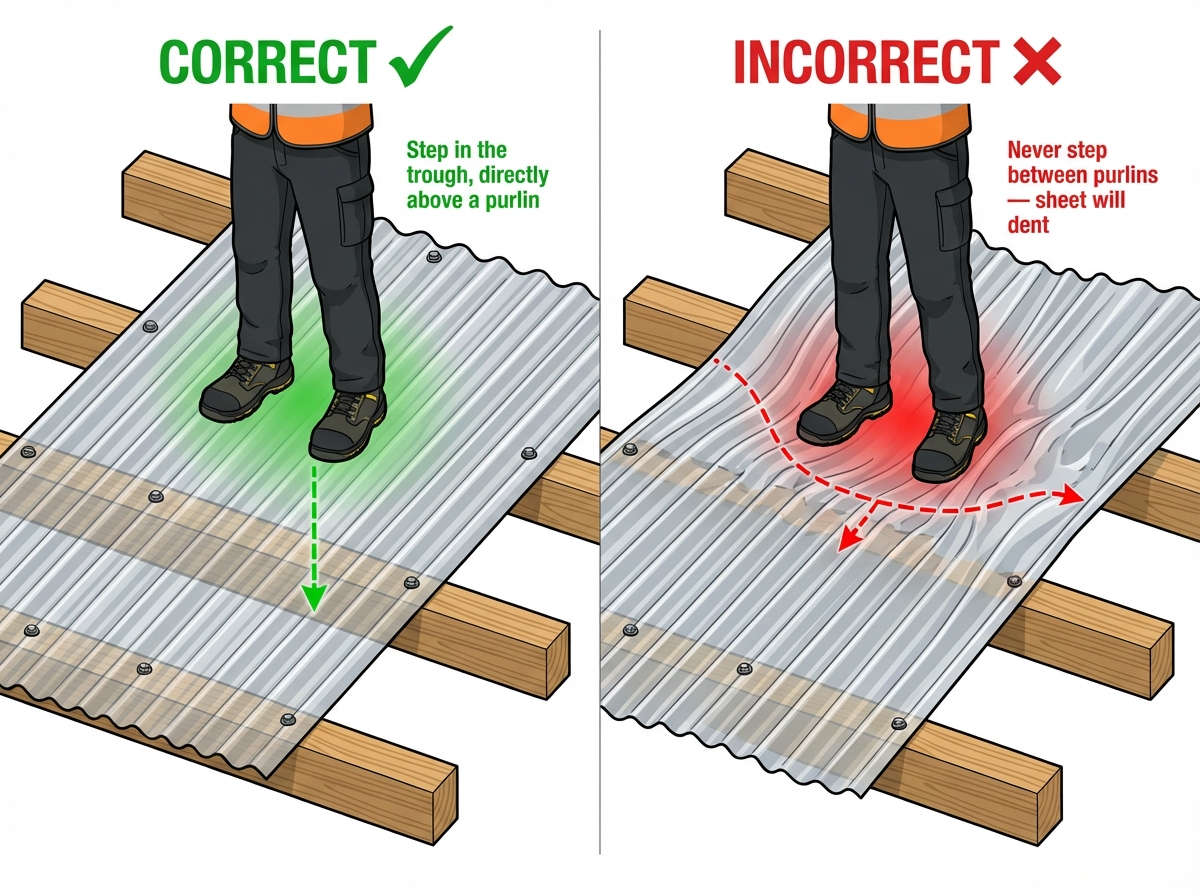
Left: correct, step in the trough above a purlin. Right: don't step between purlins or the sheet will dent.
What shoes should I wear on a metal roof?
Flat rubber-soled shoes, like clean sneakers or soft-soled work boots. Give them a wipe at the base of the ladder so you don't drag grit and metal shavings up with you. Avoid chunky-treaded soles, they collect swarf and scratch the coating every step you take.
Can I walk on corrugated iron?
Yes, carefully. The ribs are close together so you often can't fit your foot between two of them. Spread your weight over at least two ribs at once. Thinner sheets (0.40 mm) are especially vulnerable, step gently and don't linger.
Can I walk on the clear or translucent panels?
Absolutely not. Those see-through panels are not load-bearing. Treat them exactly like glass. Step near one and you're through the roof in a way nobody planned for.
Screws &
Fastening
"The right screw, in the right place, driven to the right depth. Get all three wrong and you've invented a very slow drip feature for your ceiling. Get them right and you won't think about your roof for the next fifty years."
What kind of screws are used on a metal roof?
Modern roofing screws are self-drilling with a rubber EPDM sealing washer under the head. Near the coast they need to be Class 5 corrosion-resistant. They're also available colour-matched to your roof so the job doesn't look like it was done with whatever was found rolling around on the garage shelf.
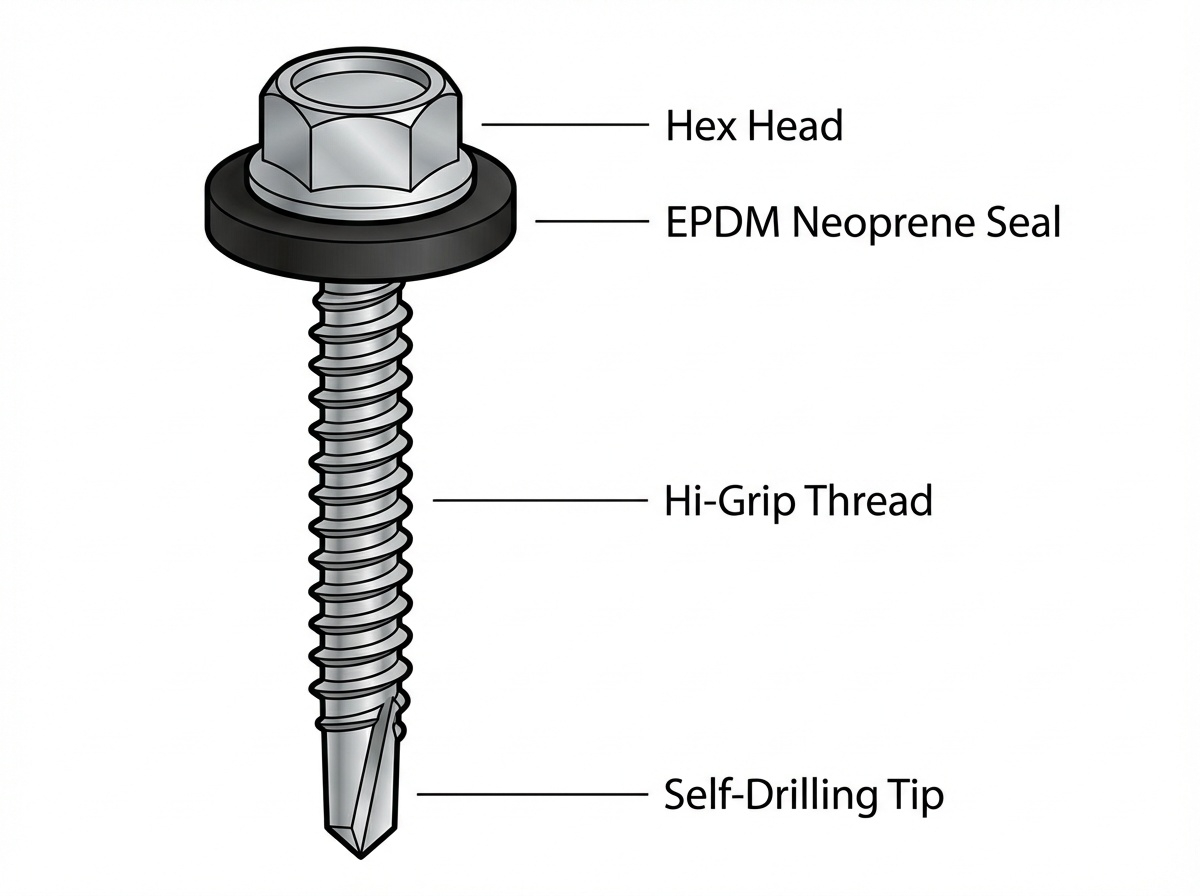
The anatomy of a roofing screw, every part has a specific job.
How tight should screws be?
Snug, not gorilla-tight. The rubber washer seals when lightly compressed. Overtighten it and the washer tears. Too loose and there's a gap for water. Modern roofing screws have a small gap on the shaft and a handful of threads closer to the head, these threads are designed to pull the roofing sheet up to the rubber washer and create a tight seal. A general rule of thumb is to slow down and tap the trigger of your drill when you reach these top threads.
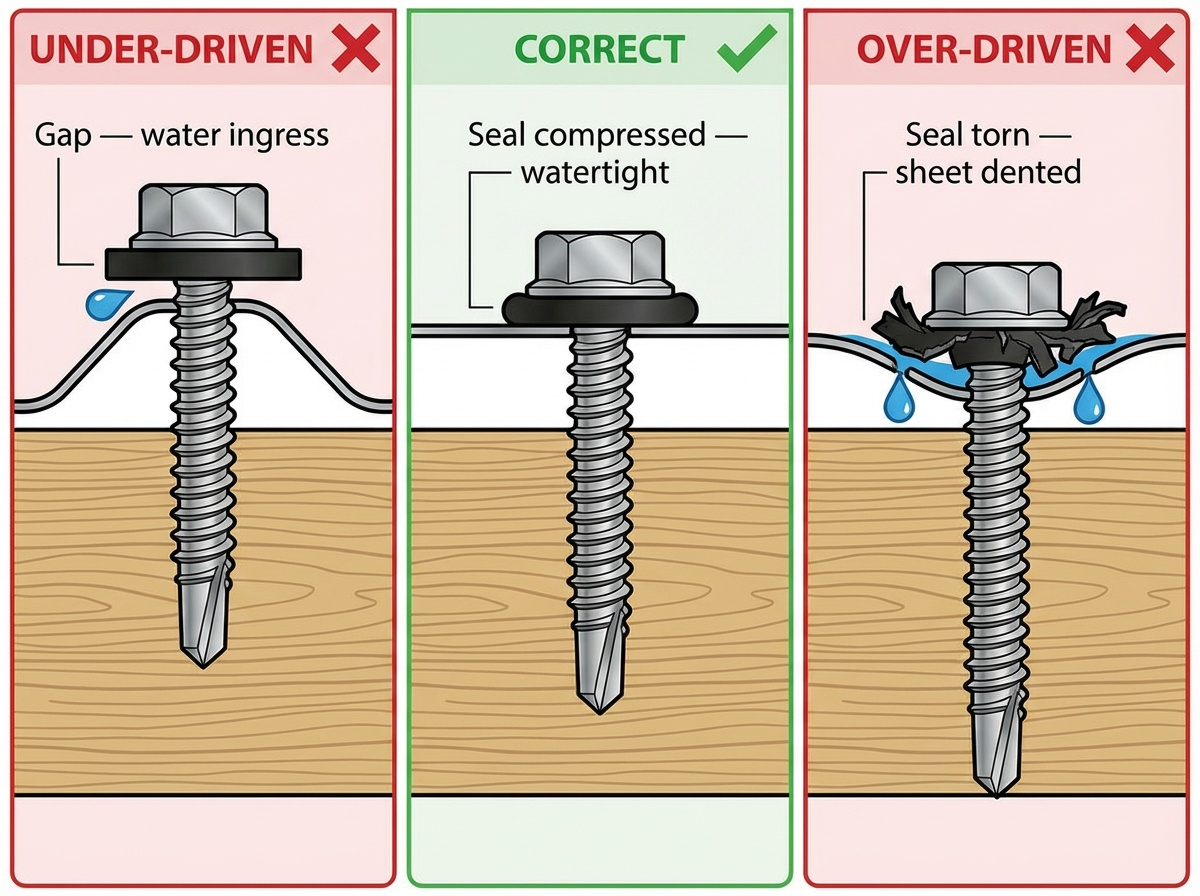
Under-driven leaks. Over-driven tears. The middle one is what you want.
Where do screws go on a metal roof?
Through the top of the rib, the high part, not down in the valley. This keeps the screw head above water level. Most roofers use standard fixing patterns to suit each wind zone. Profiles like corrugated iron do not require a screw on every single rib, unless it's down the gutter or top end, as this is where wind load will be the greatest.
How far do screws need to go into the timber?
At least 30 mm into timber, roughly the length of your thumbnail from the tip. Into steel framing, at least three full thread turns need to grip. This matters most at the edges and ridge where wind uplift is strongest.
Why do some screws have larger holes around them?
Metal expands in heat and contracts in cold. On a hot summer day, a 10-metre sheet can grow by nearly a centimetre. The oversized holes let the sheet slide under the screw head as it expands, while the sealing washer keeps it weathertight.
Can I use an impact driver to install my roofing screws?
Absolutely not. Impact drivers are far too aggressive and can damage the rubber seal, strip the coating from the screw, or snap it entirely. We recommend using a power drill with the torque set low, then adjusting it to suit after you’ve installed a handful of screws.
Maintenance &
Longevity
"A metal roof basically looks after itself. A couple of hours of maintenance a month, and a hose and brush down once a year is genuinely all most roofs need. That's a pretty good deal for fifty years of dry living."
How often should I check my roof?
Twice a year, ideally in autumn before winter hits. Look for blocked gutters, leaf buildup, anything lifted or dented, and check the sealant around pipes and skylights. Problems found early are cheap; if left five years they get expensive and wet.
Does a metal roof need to be washed?
The roof itself is mostly cleaned by rain. But wall cladding and anything sheltered from direct rain needs a manual hose-down and brush to clear sediment buildup. Coastal areas: every 6 months. Further inland: once a year.
How do I wash my roof or cladding?
A hose and soft brush. Add a splash of dish soap for grime. Water blasting is fine on low pressure, aim downward, never up under the sheet overlaps. Always finish with a rinse of fresh water. If you collect rainwater, disconnect the downpipe from the tank first.
There are orange rust stains on my new roof, is it rusting?
Almost certainly not. Those are swarf, tiny steel shavings left from drilling during installation. They sit on the surface and go rusty fast, but they're not part of the roof. A good hose-down usually removes them completely. Roofing contractors will clean the roof after completion to avoid this, if you're doing your own DIY project, make sure you clean the work area after each session. A leaf blower can help make quick work of metal swarf.
I've got moss or lichen, how do I get rid of it?
Dilute household bleach to about 2% (1 part bleach to 20 parts water). Spray or brush on, wait five minutes, rinse thoroughly. Fair warning: it'll probably grow back, that's New Zealand for you. Treat it early each year before lichen roots penetrate the paint.
Can I use an angle grinder to cut metal roofing?
Hard no. Grinders throw burning sparks that embed into the paint and rust almost immediately. Use tin snips, aviation shears, or a jigsaw with a metal blade. Slower, yes. Doesn't wreck your roof, also yes.
There's a scratch on my roof paint, do I need to fix it?
Probably not. Most small scratches blend in as paint weathers, and modern metallic coatings self-protect to some degree. If the base metal is exposed then it’s recommended to apply a clear coating. Touch-up paint is available, however due to it being a different paint system, it will weather at a faster rate and can end up making the scratch stand out after a couple of months. Rule of thumb: if you can’t see it from the ground, leave it alone.
My roof is leaking, what should I do first?
Don’t panic. Most roof leaks in Wellington are caused by something simple, a lifted flashing, a blocked valley, deteriorated sealant around a pipe, or screws that have worked loose over time. Put a bucket under the drip, then call a roofer. We do roof leak repairs across the Wellington region and can usually identify the problem with a quick inspection. The sooner you call, the smaller the fix.
Location
& Materials
"Living by the sea in New Zealand is one of life's great pleasures. Your roof has mixed feelings about it. The right product spec for your location is the single biggest factor in how long your roof lasts."
Does it matter where in New Zealand I live?
Yes, quite a lot. Coastal salt air is significantly more corrosive than inland air. In Wellington, the whole region from Petone to Island Bay cops varying levels of salt exposure. Properties within a few hundred metres of the coast need heavier metallic coatings, Class 5 screws, and sometimes different base metals. Just ask us and we'll spec the right materials for your address.
How long will a metal roof last?
A well-installed metal roof should easily last 50 years with basic maintenance, the NZ Building Code minimum. Many go considerably longer. The two things that shorten roof life: wrong product for the environment, and skipping the annual check.
Can I collect drinking water from my metal roof?
Yes, all modern pre-painted steel roofing sold in NZ is lead-free. Disconnect the downpipe from your tank before washing with detergent, and reconnect after the first decent rain rinses everything clean.
What's the minimum slope a metal roof needs?
Most trapezoidal and standing-seam profiles can go down to a roof pitch of 3°. Standard corrugated iron needs at least 8°. Too flat of an angle and water can sit on the roof and eventually find a way inside or cause corrosion.
What's the difference between longrun roofing and corrugated iron?
Longrun roofing is any metal roofing that's roll-formed in continuous lengths to fit your roof, no horizontal joins, fewer potential leak points. Corrugated iron is one type of longrun profile (the classic wavy one), but there are also trapezoidal profiles like our Trimroof and Silbery 7 which have wider, flat-topped ribs and handle lower roof pitches better. All of them are roll-formed at our Upper Hutt factory and available through both branches, with our own paint system that includes a hybrid coating offering light coastal protection as standard.
What is Aluzinc?
Aluzinc is the silver metallic coating applied to roofing steel before it gets painted. It's a mix of roughly 55% aluminium, 43% zinc, and a small amount of silicon, all bonded to the steel in a continuous hot-dip line. The aluminium forms a tough barrier that protects the steel from rust for decades. The zinc adds a self-healing effect: if the coating gets scratched or cut, the zinc reacts with moisture and seals the exposed steel underneath.
For roofing, this means the metal under your paint already has serious corrosion protection built in before the colour even goes on. Aluzinc lasts roughly four times longer than the same thickness of plain galvanised steel in most NZ environments, which is why it's now the standard base metal for almost every pre-painted roof in the country. Silbery uses Aluzinc-coated steel as the foundation under our paint system.
What is galvanised steel?
Galvanised steel is steel that's been dipped in molten zinc to stop it rusting. The zinc coating sacrifices itself slowly over time to protect the steel underneath, which is why a galv roof goes from shiny silver to dull grey as it ages.
In roofing, "plain galv" or "Z275" refers to a zinc-only coating without paint. It's the original metal roofing finish from the early 1900s, and you'll still see it on old farm sheds and woolsheds around New Zealand. These days most new roofs use Aluzinc instead because it lasts considerably longer, especially anywhere near the coast. Plain galvanised steel is still used for things like fasteners, brackets, and some industrial buildings where a raw metal finish is wanted.
What paint system does Silbery use?
Our standard paint system is a hybrid coating chosen specifically for Wellington's mixed environment. It offers light coastal protection as standard, suitable down to about 150 metres from breaking surf. For properties closer to the sea or in very severe environments, we can spec heavier marine-grade coatings on request.
The paint goes on over an Aluzinc-coated steel base, so your roof gets two layers of protection: the metallic coating defends the steel, and the paint defends the metallic coating from UV and rain. Both layers are factory-applied in continuous coil-coating lines, which gives a far more even and durable finish than anything that can be painted on site. Our paint system carries a finish warranty of up to 18 years and a perforation warranty of up to 50 years depending on your site environment. See the full warranty coverage table.
My roof ticks and pops on hot days, is something wrong?
Completely normal. Metal expands in heat and contracts in cold, on a long run of dark roofing, that movement makes noise. The installation is designed for it: oversized screw holes and expansion details at the ridge let the roof breathe. Make a cup of tea and enjoy the warmth.
Measurements
& Terminology
What is a lineal metre (LM)?
A lineal metre is simply one metre of length, regardless of width. When we quote roofing sheets by the lineal metre, we're talking about the length of the sheet only. For example, if your roof is 6 metres from the gutter to the ridge, you'd need a 6 LM sheet. The width of the sheet is determined by which profile you choose.
What does m2 mean and how do I calculate it?
m2 (square metres) is the total area of your roof. To work it out, multiply the length of the roof by the width. For example, a roof that's 10 metres long and 5 metres wide is 50 m2. Most quotes and building consents refer to roof area in m2, so it's a handy number to know before you call us.
What is roof pitch and why does it matter?
Roof pitch is the angle (or steepness) of your roof, measured in degrees. A flat roof might be 3 degrees, a standard house roof is usually between 15 and 25 degrees, and a steep roof can be 35 degrees or more. It matters because different roofing profiles have a minimum pitch they can handle. Go too flat with the wrong profile and water won't drain properly.
What is a cover width?
Cover width is the usable width of a roofing sheet once it overlaps with the one next to it. The actual sheet is wider, but once it's lapped and screwed down, only the cover width counts. This is the number you use when calculating how many sheets you need across your roof.
Ordering
& General
Do I need an account to buy from Silbery?
Not at all. We sell to everyone, trade and public alike. You don't need an account, a builder's number, or a secret handshake. Just let us know what you need and pay before we manufacture. Simple as that.
That said, if you're a business that buys regularly and would prefer monthly billing instead of paying up front each time, we do offer credit accounts. Sole traders and large construction firms alike are welcome to apply, all we ask for is a sound credit history. Apply for a credit account here.
How do I work out how many sheets I need?
If you're handy with a tape measure and confident on a ladder, you can use our basic roofing calculator to work out how many sheets you need. Otherwise, get in touch and one of our team can walk you through it or come out for a measure. We'd rather get it right the first time than have you end up short on a Saturday.
Do you install outside of the Wellington region?
Unfortunately not at this time. Our installation team covers the greater Wellington region, from the Wairarapa through to the Kapiti Coast. We'd love to expand in the future, but for now we'd rather do a great job close to home than a rushed one further afield. If you're outside our area, we can still supply materials for your local installer.
What kind of warranties do you offer?
Every Silbery roof comes with two warranties: one covering the colour and finish (resistance to flaking, peeling, and excessive fading), and one covering corrosion (no perforation through the sheet from normal weather exposure).
The exact length depends on where your house is and what it's exposed to. For mild and moderate sites, roofing finish is covered for up to 18 years and perforation for 40 to 50 years. Severe coastal sites get 15 years on the finish and 30 years on perforation. Very severe sites (right on the breaking surf) get 15 years on the finish and 20 years on perforation. For roofing, the final issued warranty is never less than 15 years.
The exact warranty for your specific address is confirmed after a quick site assessment, since coastal properties have different requirements to sheltered inland ones. See the full coverage table, environment categories, and download the warranty PDF.
Still Hungry
for Knowledge?
Keep exploring, or just ask us, we don't bite.